

The child who happily said “giagia” and “kalimera” at age four is now ten, responding in English, rolling their eyes when Greek is spoken, and drifting further from the language with every passing year. This isn’t failure. It’s a pattern — and once you understand why it happens, you can actually do something about it.
The “Understands But Won’t Speak” Stage

There’s a specific point in a Diaspora child’s Greek-learning journey that many parents recognize immediately when you describe it: the child has developed solid passive comprehension — they follow conversations, understand what grandparents are saying, pick up context — but they refuse to respond in Greek.
Linguists call this passive bilingualism, and it’s extremely common in heritage language situations. The child has absorbed a great deal of Greek through family exposure, but they’ve never had enough structured practice to feel comfortable producing the language. And when speaking feels uncomfortable or uncertain, kids avoid it entirely.
This isn’t stubbornness. It’s self-protection. Kids are acutely aware of how they sound to others. If saying something in Greek feels risky — if they might get it wrong, be corrected, or feel embarrassed — they’ll default to the language they know they can handle: English.
The good news is that passive comprehension is a genuine foundation to build on. The Greek is already there. What’s missing is the confidence to use it.
Why Kids Switch to English

Understanding why kids reach for English helps parents respond more effectively — instead of pushing harder in ways that can backfire.
English is easier, and kids know it. Greek is genuinely one of the more complex languages to learn — the grammar is rich, verb conjugations are demanding, and the alphabet alone is a hurdle (see Fun Ways to Learn the Greek Alphabet). When a child is tired, distracted, or just trying to communicate quickly, English wins every time.
School is all in English. For most Diaspora kids, their entire academic world — friends, teachers, pop culture, social media — runs on English. That’s where their identity is anchored. Greek can start to feel like a separate, external obligation rather than part of who they are.
The social stakes feel high. Kids are deeply influenced by peer environments. If speaking Greek singles them out, makes them seem different, or earns awkward looks from English-speaking friends, they’ll stop — not because they don’t value Greek, but because belonging matters enormously at this age.
There’s no immediate need. Unless a child has a strong reason to use Greek — regular contact with Greek-speaking grandparents, a Greek school they love, or a genuine personal connection to the language — it stays in the background as something optional.
Common Parent Mistakes (Made With the Best Intentions)

Most Greek Diaspora parents want their kids to learn Greek. Below are 5 of the most common mistakes they make that come from caring too much, not too little:
- Insisting on Greek at home as a strict rule. Blanket “Greek-only” rules, enforced rigidly, often create resentment rather than fluency. When a child feels forced, Greek stops feeling like a gift from their culture and starts feeling like a punishment. The language becomes associated with conflict.
- Correcting every mistake. Nothing shuts down a child’s willingness to speak faster than being corrected mid-sentence. When a kid tries to say something in Greek — however imperfect — and the response is an immediate grammar correction, the lesson they learn is: don’t try.
- Leaving it entirely to Greek school. Saturday Greek school is valuable, but one or two hours a week is rarely enough on its own. Without reinforcement between sessions, kids don’t build the fluency or confidence they need to feel comfortable speaking.
- Treating Greek as a chore. Worksheets, drills, and rote vocabulary lists have their place, but when they’re the only mode of Greek learning, kids develop a simple association: Greek is boring and hard. That association is very difficult to undo.
- Making it a big deal. Paradoxically, drawing constant attention to the fact that a child isn’t speaking enough Greek can make the problem worse. It raises the emotional stakes, increases anxiety, and turns speaking Greek into a performance rather than a natural part of life.
Creating Low-Pressure Speaking Opportunities
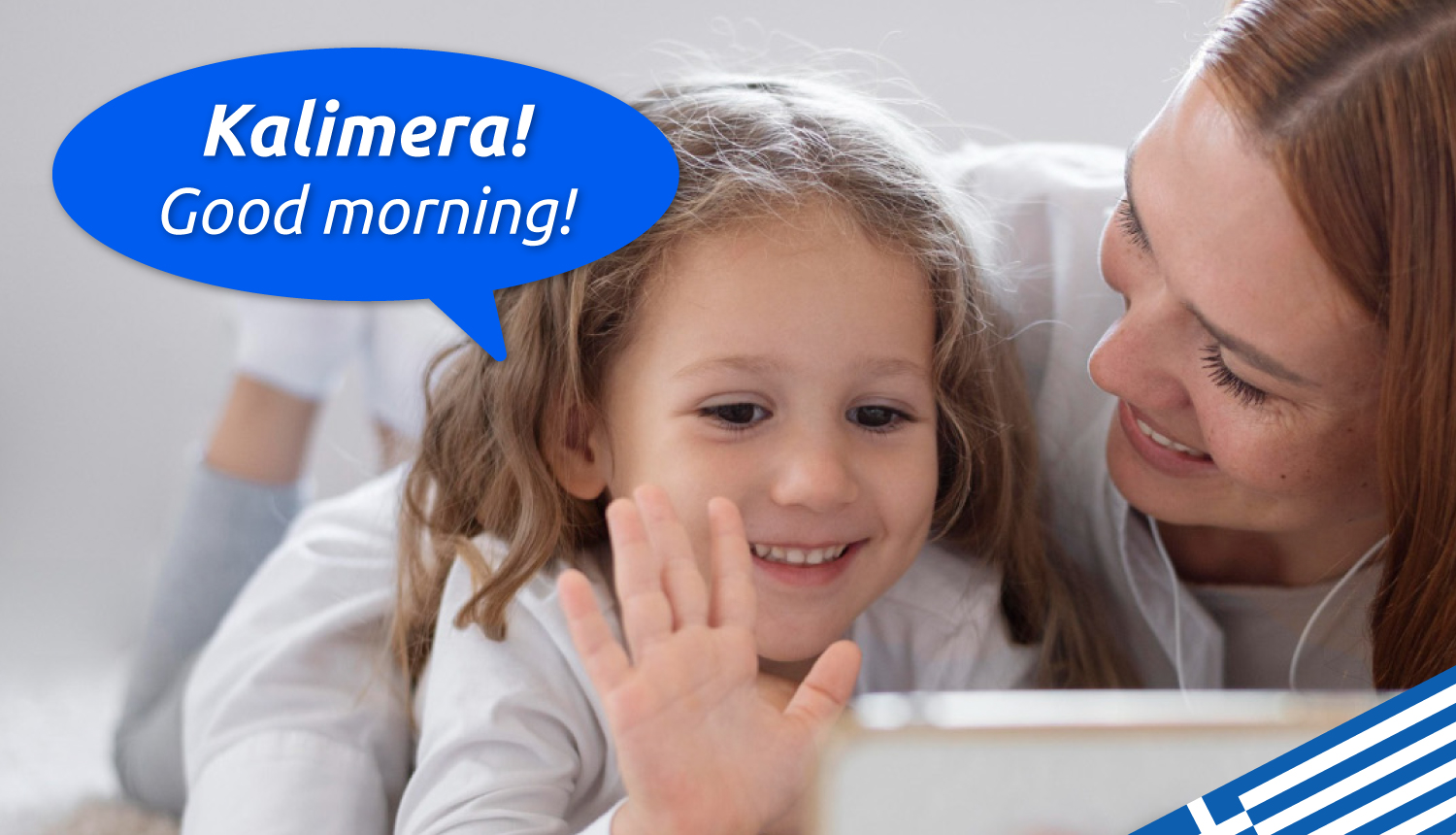
The antidote to all of the above is simple in principle: make Greek speaking feel easy, natural, and low-stakes, like a game! Here’s what that actually looks like in practice.
Start with single words and basic Greek phrases. You don’t need fluent conversations. Asking a child to say “παρακαλώ” when they want something, or “ευχαριστώ” after dinner, is a speaking opportunity. Keep the bar low and celebrate every attempt. Even the most basic Greek phrases — “kalimera,” “ti kaneis,” “poli oraia” — build the habit of reaching for Greek first.
Create contexts where Greek is the natural choice. Cooking a family recipe together and naming every ingredient in Greek. Watching a Greek cartoon with no subtitles. A video call with a grandparent in Greece where only Greek is spoken — not because you’ve declared a rule, but because giagia doesn’t speak much English. Immersive moments beat grammar drills every time.
Play games in Greek. I Spy, Simon Says, card games with Greek word labels, simple quizzes about the Greek alphabet — any game that involves Greek automatically becomes low-pressure practice. The goal is the game, not the language. The language just comes along for the ride.
Let them hear themselves winning. One of the most powerful things a child can experience is hearing themselves speak Greek and having it go well — being understood, getting it right, feeling proud. Look for ways to engineer those small wins, especially early on.
Don’t force it when emotions are high. If a child is already frustrated, tired, or upset, pushing Greek into that moment will only reinforce the negative association. Save the Greek-speaking moments for when the mood is light.
Making Greek Fun Instead of a Chore

The single biggest shift parents can make is moving Greek from the “obligation” column to the “enjoyment” column. That shift is rarely about content — it’s about context and delivery.
Kids who are learning Greek online through a well-designed platform are in a fundamentally different emotional state than those sitting at a table doing worksheet exercises. One feels like screen time. The other feels like homework. And kids are very clear about which category they prefer.
The best way to learn Greek for a child isn’t the most efficient route for an adult. Adults can push through boredom with motivation and willpower. Kids learn through engagement, repetition they don’t notice, and genuine enjoyment. If the process of learning Greek is enjoyable, kids do more of it — and doing more of it is exactly what produces fluency!
Themes matter enormously here. A child who is obsessed with space will engage completely differently with a Greek vocabulary set built around planets and astronauts than with a generic word list. A child who loves animals will happily spend 20 minutes on a Greek matching game featuring jungle creatures. Interest is the engine — Greek is the fuel that gets added naturally.
This is also why live online Greek lessons combined with a structured platform like Ellinopoula is so valuable. Because it offers the variety, visual engagement, and instant feedback that hold children’s attention in ways that traditional methods often can’t, while also ensuring proper instruction.
How Gamification Builds the Confidence to Speak

Here’s the thing that parents sometimes underestimate: confidence and speaking are inseparable. A child who feels confident in their Greek will speak it. A child who doesn’t, won’t — no matter how much they know.
Gamification, when it’s thoughtfully designed, is one of the most powerful confidence-building tools available for children learning Greek.
Immediate feedback and visible progress. Traditional language learning gives kids very little real-time information about how they’re doing. Gamified learning is different. Every activity produces an instant result — a star, a score, a level-up — and that immediate feedback loop is enormously motivating. Kids learn that trying produces results, and that mistakes are just part of the game.
The Pantheon of Students. Ellinopoula’s global monthly leaderboard gives kids a stake in their own progress. Every activity they complete earns them points that push them up the rankings among Greek-learning kids from all over the world. For many Diaspora kids, this is also the first time they’ve realized there are thousands of kids just like them — scattered across the globe, connected by the same language!
Olympian Powers. As kids move through the Learning Path and collect daily stars, they unlock mythological Olympian Powers — Poseidon’s power of exploration, Athena’s wisdom — complete with a personalized congratulatory video from an Olympian god. It sounds like pure fun, because it is. But it also means that every step forward in Greek is marked by something genuinely exciting, not just a checkmark.
Achievement Badges. Kids earn digital medals as they reach milestones in their Greek language learning journey — completing an alphabet unit, mastering a vocabulary set, finishing a themed quiz series. These badges are visible, shareable, and something to be proud of. They make progress tangible in a way that grades and test scores rarely do for young children.
Together, these features transform learning Greek from a solitary effort into something with momentum, recognition, and reward. And crucially, they let children see — concretely, daily — that they are moving forward. That evidence of progress is what builds the confidence to speak.
The Bigger Picture

A child who stops speaking Greek isn’t lost. They’re at a crossroads — and the direction they go often depends on the environment their parents build around them.
Pressure, correction, and obligation push children toward English. Low-pressure practice, genuine fun, visible progress, and the right tools pull them back toward Greek.
The families who succeed are rarely the ones who tried hardest in the conventional sense. They’re the ones who found ways to make Greek feel like something their child wanted — a source of identity, pride, and connection rather than a burden.
If you’re looking for a place to start, or to restart, Ellinopoula offers a free 7-day trial. It’s built specifically for Greek Diaspora kids — designed around game-based learning, structured progression, and the kind of gamification that turns reluctant learners into enthusiastic ones!
Because the goal was never just to have a child who understands Greek. It was always to raise a child who speaks it — and loves that they do.
Start your free 7-day trial at Ellinopoula and let your child find their Greek voice.