

It’s impressive how much Greek mythology appeals to kids, as is evident when walking into any bookstore’s kids’ section. Greek mythology for kids is a favorite choice for parents, especially for kids learning Greek, as their kids love stories about heroes, monsters, spirits, and villains.
Timeless Values Across Generations
Ancient Greeks, used myths to educate, entertain, and pass on life-lessons and timeless values from one generation to the next. They knew that imaginative and meaningful education is effective, and they put that into action. More specifically, they knew what modern anthropology confirms today: humans are “wired” to tell and listen to stories. Storytelling helped humans bond together, survive, pass on knowledge to others, and ultimately build civilizations. To this extent, no one can know precisely how ancient Greek mythology is. The origins of the characters, plots, values, and lessons found in many sections of Greek mythology may predate recorded history.

What is certain is that Greek mythology has captured the imaginations of children and adults alike for centuries; its enduring popularity among kids can be attributed to several factors: Firstly, Greek mythology is filled with fascinating stories of gods, goddesses, heroes, and monsters, offering a rich and diverse narrative landscape that captivates young minds. These tales of epic adventures, heroic feats, and supernatural beings provide a sense of wonder and excitement that resonates with children.
A Gateway into Ancient Greek Culture
Additionally, Greek mythology is a gateway for children to learn about ancient Greek culture, history, and language. By exploring the myths and legends, kids are exposed to the names of gods and goddesses, famous heroes, and iconic creatures, thus becoming familiar with the Greek language and its pronunciation. This exposure to Greek vocabulary can be an excellent foundation for learning the language.

Ellinopoula recognizes the appeal of Greek mythology and incorporates it into its features and teaching methods to engage and educate children effectively. The platform features extensive mythological content presented in an interactive and child-friendly format. This inclusion of mythology on the Ellinopoula platform creates a captivating learning environment that sparks the curiosity of young learners; in fact, we created Petros and Mythology, an original animated series about a young boy who uses his imagination and knowledge of Greek mythology to think of novel, creative solutions.

The Learning Path: Kids Learn Greek step-by-step
Furthermore, one of the key features of Ellinopoula is its Learning Path teaching method. The Learning Path is designed to guide children through a structured curriculum that gradually introduces and reinforces Greek language skills. Within this curriculum, mythology acts as a thematic thread, weaving throughout the lessons and activities. By integrating mythology into the Learning Path, children can learn Greek vocabulary, grammar, and syntax in a meaningful context, enhancing their comprehension and retention.
Live Online Classes
Moreover, Ellinopoula offers Live Online Classes, allowing children to interact with experienced Greek language instructors in real time. These live classes incorporate mythology as a topic of discussion, enabling students to practice their language skills while engaging with mythological stories and characters. This interactive approach fosters active learning and encourages students to participate actively in the learning process. Within its Live Online Classes, Ellinopoula organizes in-class virtual field-trips, which provide students with a virtual exploration of ancient Greek sites and landmarks.
Virtual Field-Trips
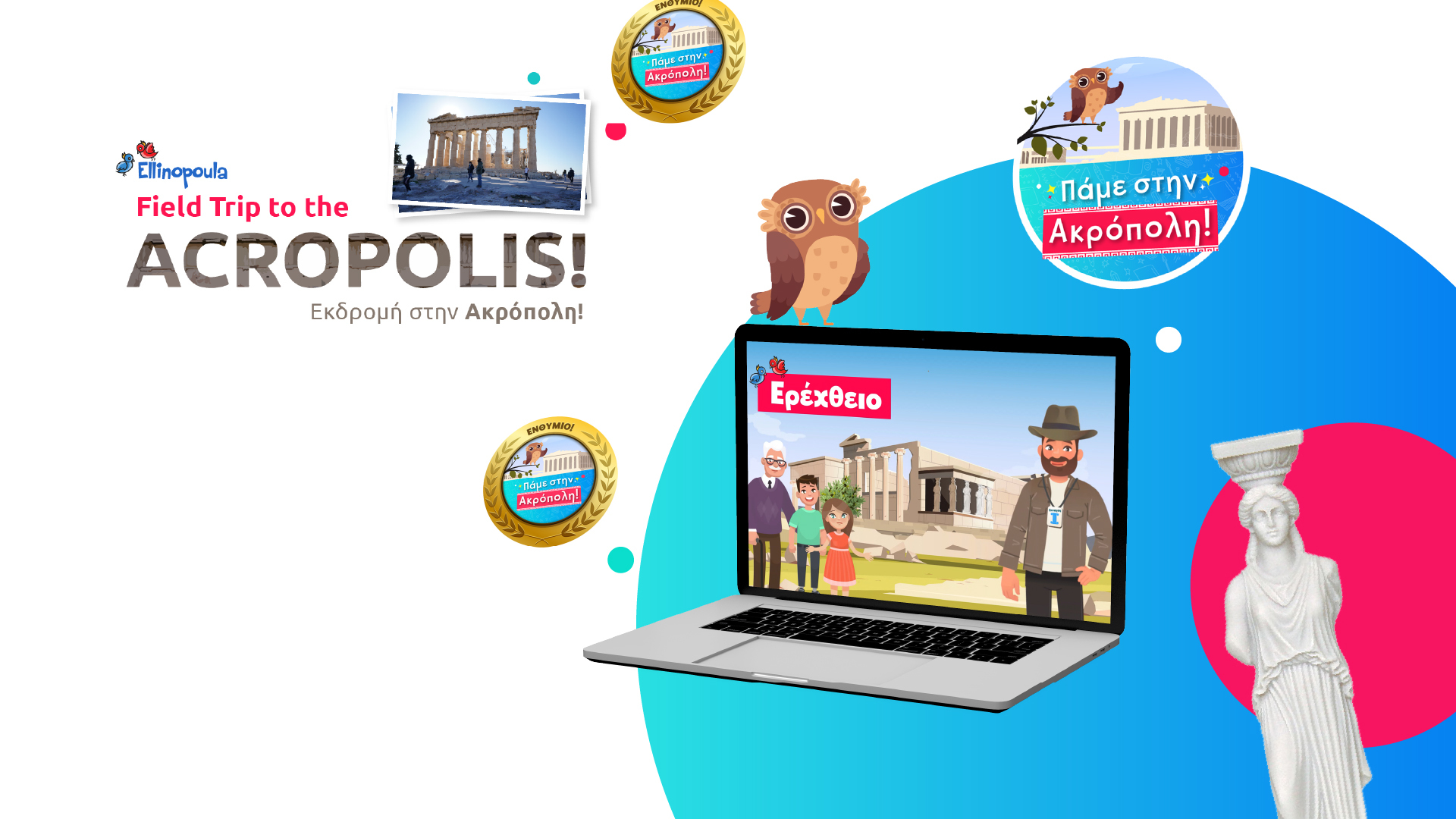
With the addition of virtual field-trips, we’ve brought Greek mythology to life and fuelled the imagination even more! Virtual field-trips offer unique advantages that surpass traditional learning methods; their digital format enables the integration of historical and mythological representations across different periods, providing a dynamic and immersive learning experience. For example, while exploring the Parthenon, children not only see the architectural marvel in its current state but can also witness the mythological battle between Athena and Poseidon for the city’s name. In this way, students are immersed in Greek mythology, discovering the places and settings associated with the myths they have learned. This immersive experience enhances their understanding of the cultural and historical context surrounding the myths, making the learning journey more comprehensive and enjoyable.
It’s Fun!
First and foremost, mythology is great fun! Kids love mythology, and arguably, every type of modern-day witch, magician, and ghost story novel and film echoes Greek mythology. Heroes, different kinds of spirits, gods, demi-gods, winged creatures, and adventurous journeys leading to some sort of conquest fascinate kids. The Minotaur, Pegasus, the Cyclops Polyphemus, the Sphinx, and the Medusa – all these mythical creatures never cease to fascinate, inspire, and entertain kids. Furthermore, kids have great fun discovering how humans interact with the gods and these mythical creatures. Specifically, they are excited to learn how these creatures try to trick humans and vice versa.
Helps Teach Greek
Greek mythology for kids goes hand in hand with Hellenism and Greek heritage. By learning about Greek Mythology, kids also learn the Greek language and vice versa. Names, locations, and epic adventures unfold through exciting stories narrated in Greek. Furthermore, Greek mythology helps kids develop a sense of wonderment and adventure about Greek words, names, and locations.
Fosters Critical Thinking
In contrast to other forms of entertainment and storytelling, Greek mythology for kids promotes critical thinking, an invaluable skill for future academic and professional success. Greek mythology for kids achieves this by making kids question the motives and decisions behind the actions of heroes and monsters. This is because kids are fascinated by heroes facing impossible challenges, protagonists facing moral dilemmas, and a multitude of gods with distinct temperaments, strengths, and weaknesses. For instance, why is Poseidon giving Odysseus a hard time getting back home to Ithaca?
Fuels the Imagination
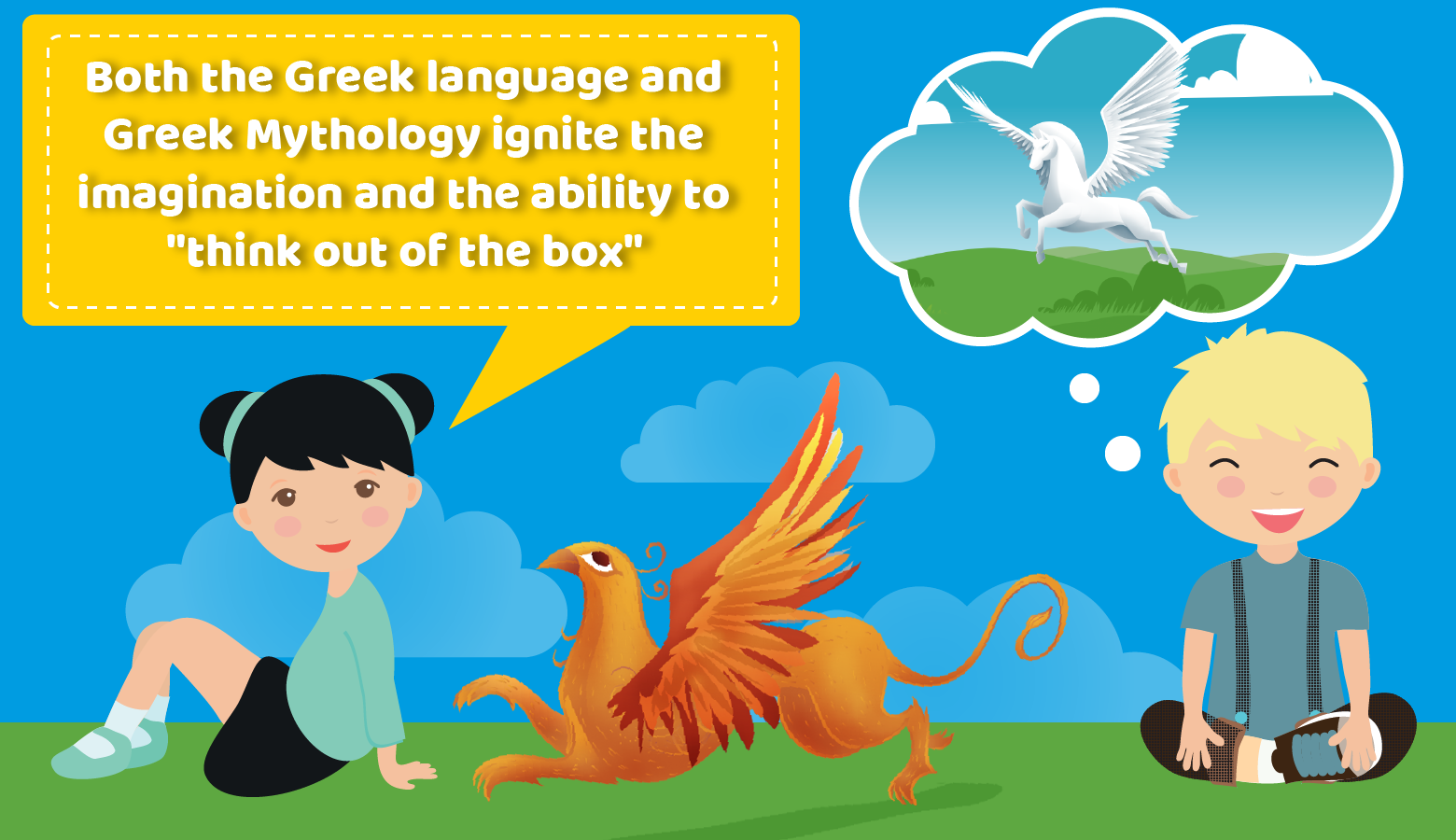
The Greek language and Greek mythology for kids fuel the imagination and the ability to “think out of the box.” In particular, the Greek language, with its multitude of suffixes, cases, tenses, and word stems, ignites reasoning and creativity in young minds. Take, for instance, the name of the Cyclops who captured Odysseus and his companions. Why “Polyphemus”? Why is his name comprised of “Poly” (many) and “phemus”(“spoken about”)? Could it be because he was fearsome and everyone spoke about him? Or is it because mothers would warn their kids to behave, or he’d come and eat them up? Could it be because he was famous amongst the other Cyclopes for being the most brutal? Besides such reasoning, kids’ literary imagination expands when they discover the power of words over brute strength. In particular, how Odysseus told Polyphemus his name was “Nobody,” and how that was instrumental in escaping from captivity.
Teaches Lifelong Lessons
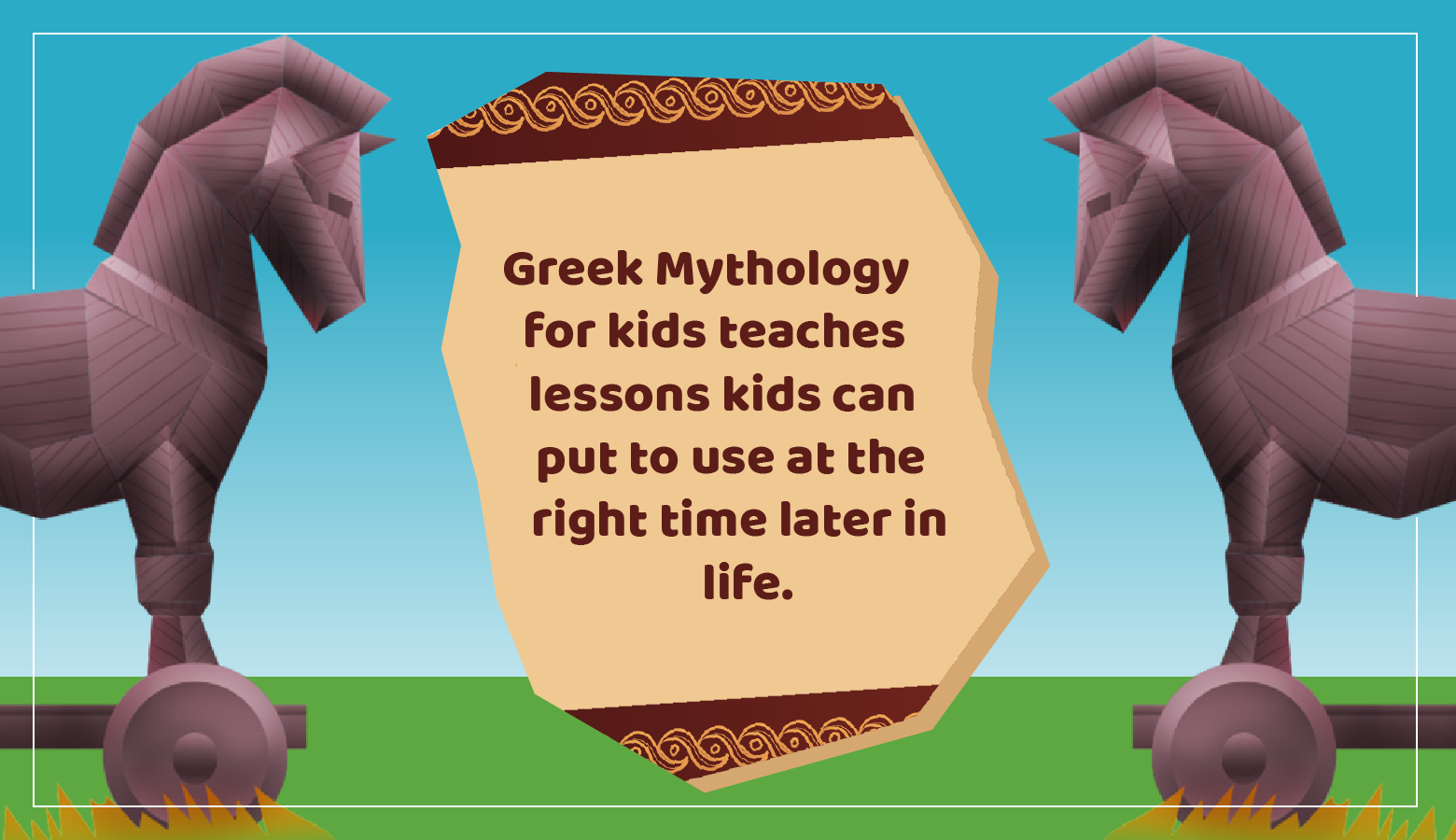
Greek mythology for kids teaches lessons kids can put to use at the right time later in life. For example, Odysseus teaches us that ingenuity and teamwork can get us out of highly adverse circumstances. Kids will see Odysseus display this quality when he comes up with the Trojan Horse idea and how he manages to escape Polyphemus. He also teaches us that persistence is tantamount to achieving long-term goals, especially in the face of obstacles and temptations. Older kids will learn more intricate, hidden lessons, such as the negative consequences of pride and an inflated ego, like when Odysseus taunted Polyphemus after escaping, where he revealed his actual name, which resulted in Poseidon’s rage against him for blinding his son.
Promotes a Well-Rounded Education
Greek mythology for kids can answer why there are so many NASA space shuttles named “Apollo.” Furthermore, kids can learn about all the stories of the gods and heroes who lent their names to the planets and constellations. They get to learn the meaning behind such expressions as “Herculean task,” “caught between Scylla & Charybdis,” and “the Midas Touch” – all of which a part of a well-rounded education.
Teaches Allegory
Ancient Greeks knew myths can teach allegory and that archetypal stories resonated with deeper meanings. For instance, the story of Daedalus and Icarus carries multiple lessons for a child to learn. Such lessons could range from the more basic and straightforward “it pays to listen to your parents” to “carelessness and pride are dangerous” to “the passion of youth should be moderated by the wisdom of old age.” Another example of how Greek mythology for kids engages higher-order cognitive functions is the myth of Oedipus and the riddle of the Sphinx. Kids will notice that Oedipus correctly answers the Sphinx’s famous riddle by analogizing the three stages of life (youth, adulthood, and old age) with the morning, noon, and evening. This analogy teaches kids the concept of “life stages,” a crucial concept for kids to grasp on their journey of maturing into teenagers and adults.
How We Integrate Greek Mythology for Kids
We incorporate beautifully colored Greek-themed backgrounds, video series, activities, games, and virtual field-trips. Our content features the Odyssey, Aesop’s Fables, and other famous gems of Greek heritage, such as the stories of Theseus, Jason and the Argonauts, and Achilles. Furthermore, our exclusive structured learning method – the Learning Path – is themed in the style of the Labors of Heracles. Just like Heracles proceeded from one labor to the next, so do young learners of Greek in their journey to master the Greek language.
One of our most popular games is based on Greek mythology: “Heroes and Monsters” is a beautifully illustrated board-style game where kids pick a hero and turn the wheel to advance towards the mythical city of Atlantis with monsters and the hissing Medusa standing in their way. Also, we recently launched Titan Clash, a fast-paced game that combines the classic game of “Hangman” with the fascinating world of Greek mythology for kids to practice their Greek vocabulary! To make it even more exciting, we made it a 2-player game where kids choose from Greek mythology gods, including Ares, Artemis, Athena, and Zeus, to compete against each other and emerge as the Champion of Mount Olympus!
Overall, Greek mythology’s popularity stems from its timeless, captivating, and imaginative stories. Ellinopoula recognizes this appeal and effectively incorporates mythology into its platform through all types of features and content. Through features such as the Learning Path, Live Online Classes, and in-class virtual field-trips, Ellinopoula creates an engaging and immersive learning experience that helps children learn the Greek language and develop a deeper appreciation for Greek culture and history.