
Behind every game, every quiz, and every activity on Ellinopoula lies a carefully thought-out educational framework — developed by an academic team with deep expertise in language education. This post pulls back the curtain on that framework and explains why helping kids learn Greek through play isn’t just enjoyable. It works.
Fun, Play, and Games Are Not the Same Thing
These three words get used interchangeably all the time, but in education research they mean quite different things — and understanding the difference helps explain why Ellinopoula is built the way it is.
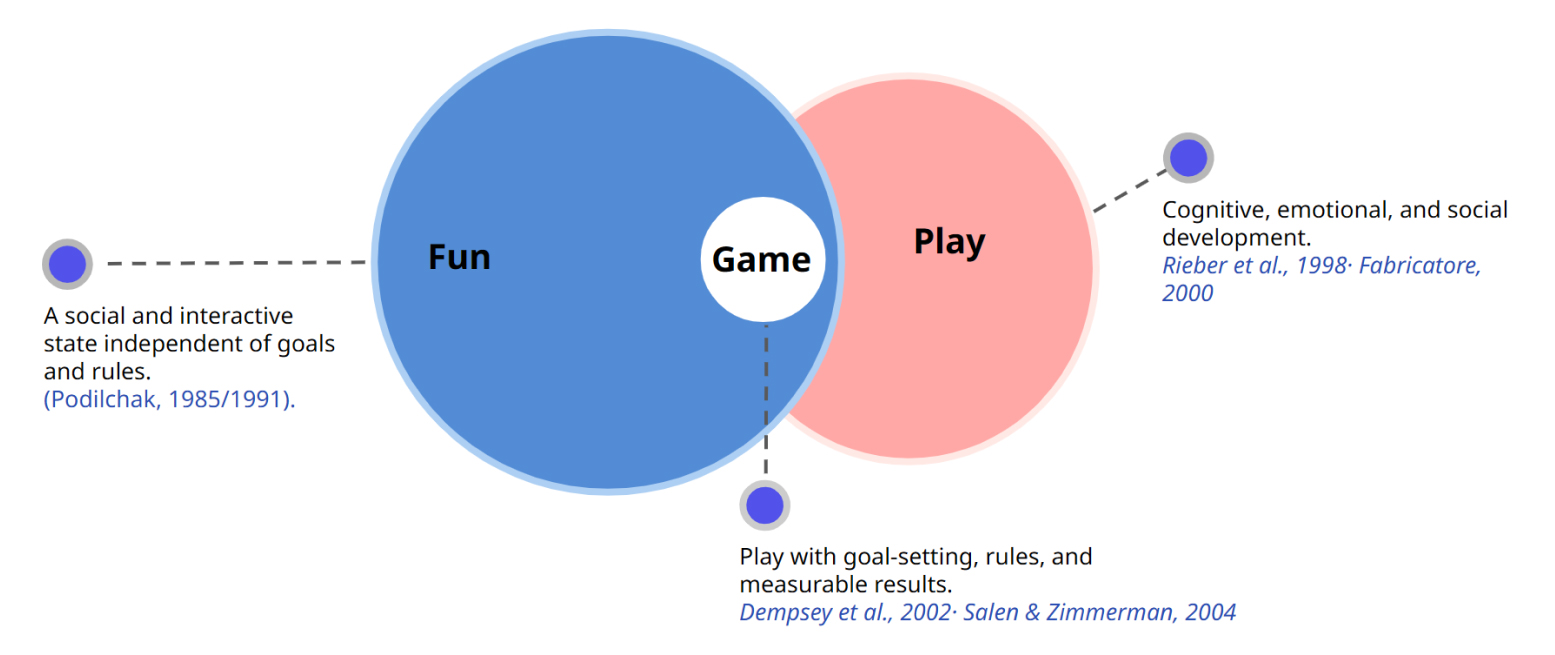
Fun is the simplest of the three. It’s a feeling — the easy, relaxed state of enjoying yourself without any pressure or agenda. Fun matters in learning because it lowers a kid’s guard. A kid who is having fun is open, relaxed, and far more likely to absorb what’s in front of them.
Play is more purposeful. Kids play because they want to — no one has to force them. And according to researchers, good educational play always has three things in common: goals, rules, and interaction. Those three ingredients are what separate productive play from passing time. Study after study confirms that play is one of the most effective ways to help kids learn and develop a wide range of skills.
Games are the most structured of all. A game is essentially play with a clear purpose — it has rules, measurable outcomes, and a goal to work toward. When a game is designed with learning in mind — when playing the game and learning the subject happen at the same time — researchers call it an educational game. It’s not entertainment with a learning side-effect. The learning is the whole point.
Think of it this way: Fun is what gets a kid to the table. Play is what keeps them there. The game is how they learn — and learning Greek is the result.
Why Play Is So Powerful for Kids Learning Greek
Play isn’t just a nice way to spend an afternoon. Research tells us it is genuinely critical for kids’ development across four areas — and each one is directly relevant to Greek Diaspora kids working to learn Greek as a second language:
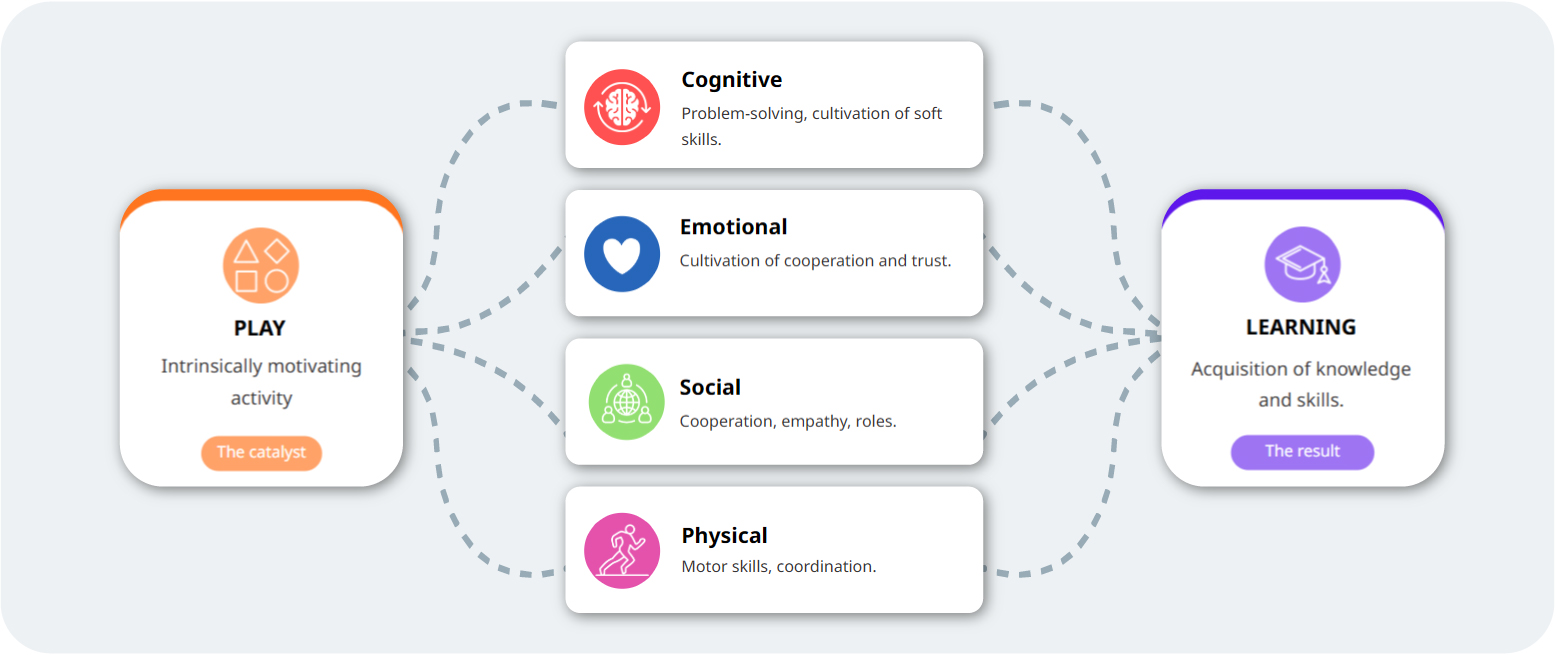
Thinking and problem-solving. When a kid figures out the right Greek word, recognizes a letter under time pressure, or chooses the correct form of a noun in a grammar game, they are actively building mental pathways — not passively receiving information. The challenge is the learning.
Emotional resilience. One of the biggest barriers for Diaspora kids learning Greek is the fear of getting it wrong. Play changes that. In a game, making a mistake is just part of the experience — you try again. That safe-to-fail environment builds confidence in a way that traditional exercises rarely do.
Social connection. Even in a solo digital game, well-designed activities give kids a sense of belonging and shared purpose. For Greek Diaspora families whose kids might not have many Greek-speaking peers nearby, this sense of being part of a wider Greek-speaking community matters enormously.
Physical engagement. Clicking, typing, responding quickly, interacting with the screen — for younger kids especially, this hands-on physical involvement reinforces memory and helps keep attention sharp.
Game-Based Learning: The Approach Behind Ellinopoula’s Design
The concept that ties all of this together has a formal name: Game-Based Learning, or GBL. In simple terms, it means using games as the actual method of teaching — not as a reward at the end of a lesson, but as the lesson itself. Every learning activity on Ellinopoula follows this design logic:

Start with the theory. What does research tell us about how kids pick up vocabulary, grammar, or reading skills in a second language? That’s the foundation every activity on Ellinopoula is built on.
Design the mechanics around it. Teaching Greek noun-article agreement, for example, requires a kid to practice matching the right article to the right noun — repeatedly, in varied contexts, until it becomes natural. The game mechanics are chosen specifically to make that practice happen.
Wrap it in an engaging format. The same exercise that would feel like a worksheet becomes something a kid wants to do when it’s built into a game with a character, a challenge, and a reward.
Measure the result. Knowledge gained, skills practiced, problem solved.
This is why a kid playing a grammar or vocabulary game on Ellinopoula isn’t just having fun while Greek learning happens in the background. The game is the learning — by design.

The Ellinopoula Learning Path: A Structured Journey, Step by Step
This is also where Ellinopoula’s Learning Path comes in. Rather than leaving kids to pick activities at random, the Learning Path guides Greek Diaspora kids through a structured, step-by-step progression — each step made up of games, videos, quizzes, and interactive activities that build naturally on each other. It’s the backbone of the platform: a clear route from where a kid starts to where they need to go, with every stop along the way purposefully designed around game-based learning principles.
Gamification: The Engine That Keeps Kids Motivated
Knowing how to design a good educational game is one thing. Keeping kids motivated to keep showing up is another. That’s where gamification comes in — the use of game-style rewards and mechanics to drive ongoing engagement.
Ellinopoula uses several of these mechanics in ways that are particularly well-suited to Greek Diaspora families:

Points and stars. Every activity a kid completes earns them points. As they move through the Learning Path each day, they fill their energy bar and earn stars — collect 10 stars and they unlock a mythological Olympian Power, like Poseidon’s power of exploration, and a personalized congratulatory video message from an Olympian god.
Achievement badges. Kids earn digital medals as they hit milestones in their Greek learning journey — completing an alphabet unit, mastering a vocabulary set, finishing a themed quiz series. These badges can be displayed on their profile or printed out, giving kids something tangible to be proud of.
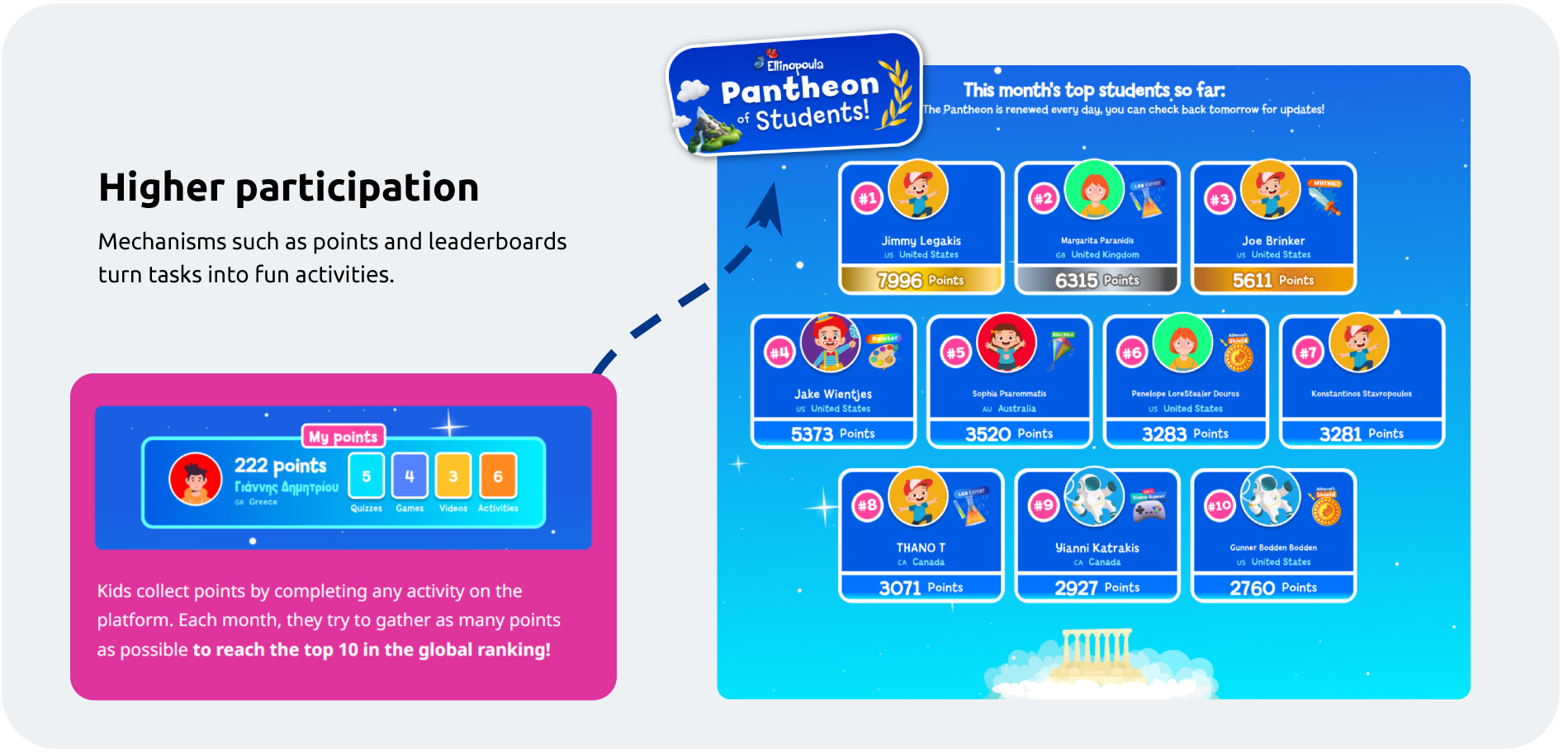
The Pantheon of Students. This is Ellinopoula’s global monthly leaderboard — and one of the most beloved features among students. Every time a kid engages with the platform, they earn points that push them up the rankings.
What the Research Tells Us About Why This Works

Gamification, when done well, delivers real benefits for learners. Here’s what that looks like in practice on Ellinopoula:
- Kids progress at their own pace, because the platform adapts to where they are rather than where a classroom average says they should be.
- Instant feedback after every activity helps kids immediately understand what they got right and what to try again — building the habit of persistence rather than the fear of failure.
- The ability to repeat activities in a low-pressure environment means a kid who struggles with a concept isn’t penalized — they simply try again, and again, until it clicks.
- Multimodal content — visuals, audio, interactive tasks — means kids with different learning styles all find something that works for them.
- The combination of individual challenges and global rankings supports both independent learning and healthy motivation to keep going.
For Greek Diaspora families where parents may not speak Greek fluently themselves, these features are especially valuable. The platform does the teaching — and the gamification does the motivating.
Ellinopoula Isn’t Just Fun. It’s Built on Education Science

Every activity on Ellinopoula has been built on a foundation of educational research — designed to help Diaspora kids learn Greek as a second language in the most effective way we know how. The games are real games. The play is purposeful play. The Learning Path is a carefully sequenced curriculum. And the gamification — the stars, the badges, the Olympian Powers, the Pantheon — isn’t decoration. It’s the engine that keeps Greek Diaspora kids coming back, day after day, step by step, until the language they were born connected to becomes one they truly own.
Ready to see it in action? Start your free 7-day trial at Ellinopoula and let your kid play their way to Greek.
References
Abbasi, A. Z., Hassan, M., Rehman, U., Hlavacs, H., Ting, D. H., & Shah, M. U. (2021). How engagement with gamified applications impacts quality of life: A conceptual model. In HCI International 2021 – Late breaking papers: HCI applications in health, transport, and industry (pp. 3–10). Springer.
Dell’Aquila, E., Marocco, D., Ponticorvo, M., Di Ferdinando, A., Schembri, M., & Miglino, O. (2017). Learn to lead: An educational game for leaders to be. In Educational games for soft-skills training in digital environments (pp. 123–140). Springer.
Dempsey, J. V., Haynes, L. L., Lucassen, B. A., & Casey, M. S. (2002). Forty simple computer games and what they could mean to educators. Simulation & Gaming, 33(2), 157–168.
Gee, J. P. (2003). What video games have to teach us about learning and literacy. Palgrave Macmillan.
Homer, B. D., Plass, J. L., & Blake, L. (2020). The effects of video on cognitive engagement in a science simulation game. Computers & Education, 149.
Kirriemuir, J. W., & McFarlane, A. E. (2004). A literature review on games and learning. Nesta Futurelab.
McGonigal, J. (2011). Reality is broken: Why games make us better and how they can change the world. Penguin Press.
Podilchak, W. (1985). The social organization of “fun.” Loisir et Société / Society and Leisure, 8(2), 685–691.
Podilchak, W. (1991). Distinctions of fun, enjoyment and leisure. Leisure Studies, 10(2), 133–148.
Prensky, M. (2001). Digital game-based learning. McGraw-Hill.
Reeves, B., & Read, J. L. (2009). Total engagement: How games and virtual worlds are changing the way people work and businesses compete. Harvard Business Press.
Rogers, R. (2017). The motivational pull of video game feedback, rules, and social interaction: Another self-determination theory approach. Computers in Human Behavior, 73, 446–450.
Salen, K., & Zimmerman, E. (2004). Rules of play: Game design fundamentals. MIT Press.
Schell, J. (2008). The art of game design: A book of lenses. Morgan Kaufmann.
Smiderle, R., Rigo, S. J., Marques, L. B., de Miranda, P., Coelho, J. A., & Jaques, P. A. (2020). The impact of gamification on students’ learning, engagement and behavior based on their personality traits. Smart Learning Environments, 7(1), 3.
Zichermann, G., & Linder, J. (2013). The gamification revolution: How leaders leverage game mechanics to crush the competition. McGraw-Hill.